
Estonian Company Chemestmed Develops RNA-Based Drug Candidates to Combat Severe Diseases
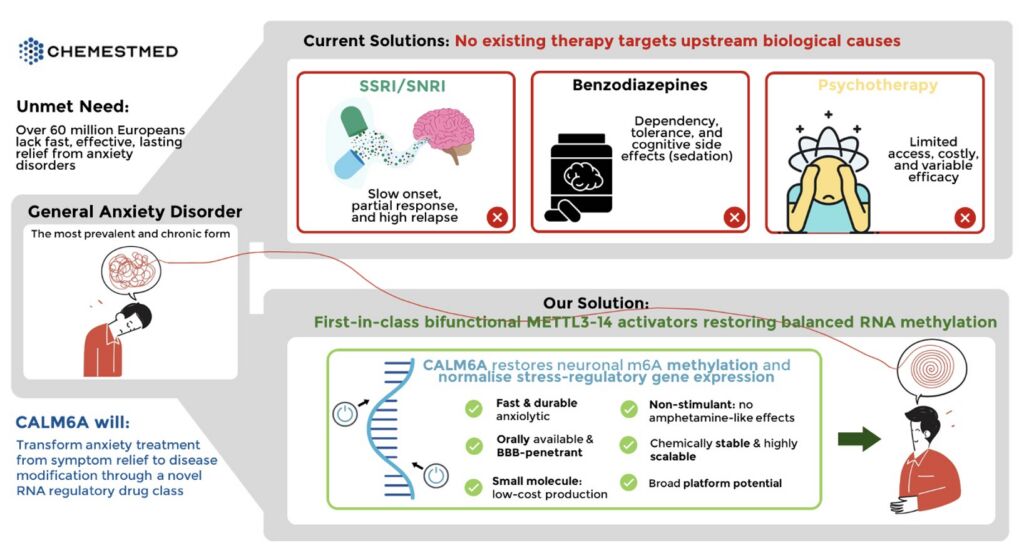
Neurodegenerative diseases such as Parkinson’s and Alzheimer’s, as well as cancer, are among the illnesses for which researchers worldwide are seeking new and more precise treatment options. Chemestmed, an Estonian company and member of the Tehnopol HealthTech community, is developing drug candidates aimed at influencing disease progression through a novel mechanism: restoring and regulating the balance of RNA methylation.
RNA methylation, and more broadly epitranscriptomics, is a rapidly evolving scientific field, increasingly recognized for its role in understanding the development and progression of several severe diseases. Chemestmed’s work focuses primarily on slowing neurodegenerative diseases and exploring cancer therapies, while the company’s scientific platform also has applications in other areas.
Company background
Chemestmed was established in 2011. The idea for the company emerged from discussions between an entrepreneur and a scientist, sparking an interest in drug development. In collaboration with academician Mati Karelson, the team decided to create a company focused on developing drug candidates that regulate RNA methylation. Since 2016, this has been the company’s main focus.
“When Chemestmed started in this field, there were only a few dozen scientific publications per year on m6A RNA methylation and epitranscriptomics. Today, there are over 2,000 publications annually. This shows how rapidly the field has developed and highlights its scientific and industrial potential,” said Chemestmed’s founder and CEO, Neinar Seli.
Science, business, and international expertise in one team
Over the past two years, Chemestmed’s team has grown significantly. The core team includes academician Mati Karelson, bio-pharma expert Erik Allikmets, with more than 30 years of experience, and Sigrid Selberg, Head of R&D, coordinating the company’s scientific projects and development activities.
Allikmets previously served as Vice President at Danish pharmaceutical company Lundbeck for over twenty years, contributing to the launch of several key psychiatric drugs. Chemestmed’s scientific team also includes computational chemists, analytical chemists, and microbiologists.
The company collaborates with international research partners, including University College Dublin, Imperial College London, University of Tartu, and University of Helsinki. Chemestmed emphasizes that combining diverse scientific expertise is critical for addressing complex drug development challenges holistically.
Chemestmed maintains long-term collaborations with the University of Tartu and University of Helsinki, resulting in multiple scientific publications. By the end of the year, a project with the University of Tartu, testing Chemestmed drug candidates in anxiety disorder models, will reach its final phase. This project is supported by Enterprise Estonia. The company is also engaged in collaborations with University College Dublin and FutureNeuro, with new projects being prepared with Imperial College London.
International recognition accelerates development
One of Chemestmed’s most notable recent achievements is the European Commission’s funding of the CALM6A project through the EIC Pre-Accelerator program. The project aims to develop novel bifunctional RNA drugs for treating anxiety disorders.
The funding competition was highly selective: out of 1,056 applications, only 70 projects were supported. Evaluation considered scientific novelty, technological feasibility, and the team’s ability to implement the project. For Chemestmed, this funding represents a significant international quality mark, validating both the scientific potential and the company’s readiness for the next stages of development.
“The CALM6A project builds on Chemestmed’s long-term RNA research. Support from the European Commission allows us to advance the project more quickly over the next two years and strengthen both our technological and business readiness,” explained Seli.
He noted that interest in their work has clearly increased over the past year. Chemestmed has become more visible in both the scientific and business communities, receiving more collaboration requests, and international pharmaceutical companies have shown interest in their technologies.
Strategic planning and intellectual property are key challenges
Drug development is a long and complex process, where scientific breakthroughs must be accompanied by strong intellectual property protection. Chemestmed identifies one of the main challenges in the field as creating a strategy that safeguards the company’s interests while providing a solid foundation for further technological development and commercialization.
Collaboration is critical for small companies in internationalization
Public-private collaboration plays a vital role in drug development. In Estonia, Chemestmed’s partners include the Enterprise Estonia, Tehnopol, and University of Tartu. The company notes that their role goes beyond project funding and advice, also helping to create international contacts and collaboration opportunities.
Seli highlighted participation in the Swiss Biotech Day delegation, which included a visit to Roche’s manufacturing facility and a separate business meeting with Roche representatives to discuss strategic interests, collaboration opportunities, and innovation needs.
“Establishing such contacts would be much more challenging and resource-intensive for a small biotech company alone. Joint visits help create new collaborations, increase visibility for Estonian companies, and accelerate internationalization,” he said.
A unique scientific focus
Chemestmed distinguishes itself through its scientific novelty and long-term focus. Ten years ago, epitranscriptomics was a narrow niche, whereas today it is a rapidly growing field attracting interest from both academic institutions and the pharmaceutical industry. The company sees this as confirmation that the chosen direction is well-timed.
In the coming years, Chemestmed plans to advance its drug candidates through further development stages and establish itself as an internationally recognized partner for both academic institutions and pharmaceutical companies. Over a five-year horizon, the company aims to become a leading developer of epitranscriptomic drugs.
“Drug development requires time and patience, but the impact of successful solutions is global. Our ambition is to create a science-based company born in Estonia, whose technologies reach millions of people worldwide,” said Seli.
You might be interested in
The next leap forward in Estonian healthcare depends on collaboration and a willingness to change
Estonia is seeing more healthtech companies and new solutions emerge than ever before, but the healthcare system’s capacity to adopt them has not kept pace. At a panel discussion during Tervisekogukonna Kärajad,...

From scientific discovery to real-world impact: What researchers should know about entrepreneurship
Turning a scientific discovery into a successful business requires more than innovative technology. Researchers must learn to identify real-world problems, work with experts from different fields and understand what it takes to...

New digital support platform for cancer patients being tested in Saaremaa
A pilot project has been launched in Saaremaa to develop and test a digital support environment for cancer patients. The aim of the solution is to bring together information about services supporting...