
Startup story: Setvox X Film and Multimedia Accelerator
Each year, dozens of high-potential startups develop their products and services in Tehnopol’s accelerator programmes. One of the teams currently participating in the Film and Multimedia Accelerator is Setvox.
Setvox is a hardware and software solution designed for film, TV series and commercial sets that turns conventional radio communication into a real-time, searchable digital text stream. The device connects to the set’s radio network, keeping the whole crew synchronised in real time and helping to prevent costly downtime caused by lost information.
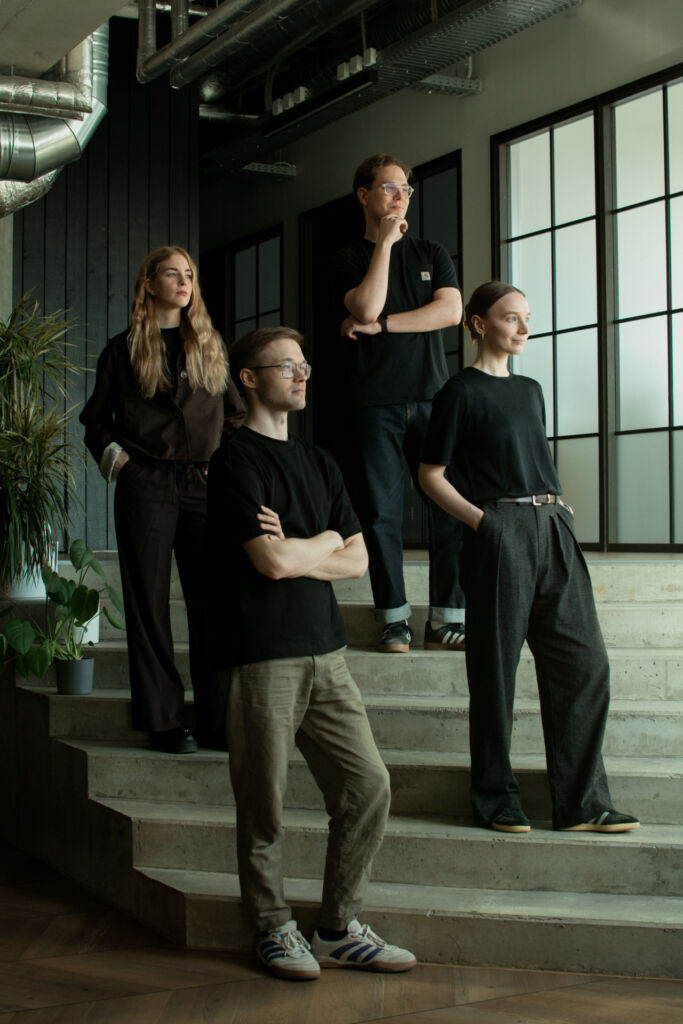
Setvox was founded by Andreas Jõesaar, Lennart Mathias Männik, Gete Tiirats and Kätleen Noormägi. The core team consists of former film students from the Baltic Film, Media and Arts School (BFM). Thanks to this background, the founders have first-hand experience of the film industry and a strong understanding of the everyday bottlenecks and pain points on set. Lennart Mathias Männik and Andreas Jõesaar shared more about Setvox’s journey.
How did you come up with the idea to create a startup?
“We had worked on different projects together as course mates, travelled together, exchanged ideas about the future of the audiovisual industry and, more broadly, discussed how we might bring about change in the creative industries.
At one point, Andreas found a film-focused bootcamp and it did not take long for all of us to agree that we had to go. So we travelled to Jõhvi together and jumped headfirst into the unknown.
At the end of two intensive days, we won the Tech Bootcamp organised by IDA Hub and Tehnopol’s Film and Multimedia Accelerator. That meant it was time to start developing the idea properly and turning it into reality – all alongside our everyday work in film. Challenge accepted!”
What have been the biggest challenges or failures, and the biggest wins so far?
“Our team consists of talented and motivated young people who share both a creative passion for storytelling and a desire to build something practical that creates wider value for the industry.
One of our biggest challenges has been adapting to the rhythm of startup life, because the pace here can sometimes be even faster than a 12-hour day on a film set. Being industry specialists who are finding our footing in the startup world is definitely an advantage, but it is also a challenge, because film work itself is extremely intensive.
Another challenge has been managing expectations around timing. The goals you hope to reach within the first six months do not always materialise that quickly. Despite the rapid development and widespread use of AI, building a reliable software solution still requires considerable time and dedication.
Alongside these challenges, there have also been important wins. The most significant one for us has been creating a working prototype. The computer-based Setvox system is now up and running. It still requires further development and continuous training, but we can already test it on film sets, gather feedback from users and keep improving Setvox based on those insights.”
What sets Setvox apart from competitors?
“Setvox was created by people from within the industry and is focused on the end user, with the aim of making everyday life on film sets easier while modernising outdated radio communication technology.
We do not want to replace the walkie-talkies that already work and that crews are familiar with. Instead, we enhance the existing technology and create additional value on top of the hardware already in use.”
Why did you apply to the Film and Multimedia Accelerator?
“We live in a time when green topics are beginning to reach saturation, the defence industry is attracting more and more attention, and the AI race is becoming increasingly difficult to win. Alongside all of this, we should remember what makes us thinking human beings – culture and creativity.
At the same time, we are interested in entrepreneurship and keen to test new possibilities. The Film and Multimedia Accelerator felt fresh, new and outside the box. We were drawn to the opportunity to innovate in our own field with the support of Tehnopol and strong partners.
It is an environment that has already helped successful startups grow, and we would like to become one of the companies that creates change and, through that, brings added value to Estonia as a country known for nurturing startups.”
Where do you see your startup in 1 year? And in 5 years?
“By now, we have realised that if you do not plan ahead and set goals, you will not reach them. Simply putting those goals into words already gets you halfway there, even if they change after six months and do not materialise exactly as originally imagined.
In one year, we see Setvox establishing a foothold in the Estonian market and our system becoming a normal part of everyday work on film sets. We want to be strong partners for production companies and equipment providers, and most importantly, we want the people working on set to genuinely benefit from our system.
Looking further ahead, we also allow ourselves to dream bigger. While staying realistic, our aim is for Setvox to be in use beyond Estonia by 2028, including in larger markets such as the United Kingdom and Germany. These are difficult markets to enter, but they also have extensive film production ecosystems.
Alongside those ambitions, we are setting concrete goals so that in five or ten years’ time we can bring new solutions to the market and, who knows, perhaps apply the knowledge we have gained from the film industry to other sectors as well.”
Who is the next Estonian unicorn?
“We are convinced that Estonia’s next unicorn will come from Tehnopol. It is a great place for bringing good ideas together and building a strong community.
We follow with interest what both defence technology companies and AI developers are doing, including the work of Estonian tech entrepreneur Jaan Tallinn. The momentum in these fields also has a wider impact on Estonia’s startup ecosystem.
Since we are filmmakers ourselves, there has also been a major step forward for our own industry in Estonia: the completion of the IDA Hub studio complex and innovation centre. This may not seem extraordinary to the general public, but having facilities and infrastructure like this gives a significant boost to the development of the sector.
With that in mind, we dream that Estonia’s next unicorn could come from the audiovisual industry. If we look at consumption habits, people have never watched as much moving-image content as they do today. That makes the ability to distinguish high-quality content from all the surrounding noise increasingly important.
There is plenty to think about here, and we should certainly not rule out the possibility that Estonia’s next unicorn could come from the film and multimedia sector.”
Which books, podcasts, publications and people in your field do you follow and recommend to other aspiring entrepreneurs?
“We definitely recommend Sprint by Jake Knapp, John Zeratsky and Braden Kowitz. The book has had a significant influence on us, particularly in understanding the fast pace of startup life and the prototyping journey.
Sprint taught us how to test ideas quickly, validate hypotheses and put solutions in front of real users as early as possible.
At the same time, it is important to maintain some balance alongside the intensity of startup life. For us, the Estonian radio show and podcast Rahva Oma Kaitse helps with that. Its sharp humour and down-to-earth perspective keep us grounded and remind us that not everything around us needs to be taken too seriously.”
Applications for the Tehnopol Film and Multimedia Accelerator are open until 18 October. If you are developing an innovative solution for the film, multimedia or creative industries and want to take it further with the support of experienced mentors, industry experts and an international network, now is the time to apply. Read more and submit your application here.
You might be interested in
Seven companies selected for Cyber Accelerator to develop new solutions for preventing cyber threats
Tehnopol Accelerator, in cooperation with the Estonian Information System Authority (RIA) and the European Cybersecurity Competence Centre (ECCC), runs the Cyber Accelerator, which supports cybersecurity startups in developing and bringing new products...

Startup story: CineGlue X Film and Multimedia Accelerator
Each year, dozens of high-potential startups develop their products and services in Tehnopol’s accelerator programmes. One of the teams currently participating in the Film and Multimedia Accelerator is CineGlue. CineGlue is an...
From Defence Business Lab to NATO DIANA: one stage, different steps in the defence innovation journey
On 24 September, 13 defence and dual-use companies presented their solutions at the Defence Business Lab Demo Day: ten startups completing the three-month pre-accelerator and 3 alumni of the NATO DIANA Estonian...