
What separates a promising startup from a dependable defence supplier
A startup can have a strong product and still lose time in the defence market by speaking to the wrong user, customising for every conversation or testing without a clear route to adoption.
Kadri Tammai, Regional Director at NATO DIANA, will discuss these questions at Defence Innovation Day in Tallinn this September. In her view, companies need to make several decisions before meeting a military end-user, including whose problem they are solving, what operational effect the product creates, how it will perform outside ideal conditions and which customer they intend to serve first.
Building for defence starts before the first meeting
A startup does not need to begin as a traditional defence contractor. It does need to understand the conditions in which its product will be expected to work.
“A beautiful demonstration in ideal conditions is not enough,” Tammai says.
Before meeting a NATO end-user, the company should be able to explain whose problem it solves, what operational effect it creates and why its approach is better than the current alternative. Depending on the technology, founders may also need to consider cybersecurity, interoperability, contested communications, maintainability, supply-chain security and the practical requirements of deploying and supporting the product.
Defence markets involve longer timelines, several stakeholders and evidence-based decisions. Companies need to learn from users without building a different product for every conversation.
“Most importantly, the founders should see defence as a market they intend to serve, not simply as a source of grant funding,” Tammai says. “End-users can help refine a solution, but they should not have to create the company’s defence strategy for it.”
Choosing the first customer is part of that strategy. A drone-related product may be relevant to armed forces, police, airports, border authorities and critical-infrastructure operators, but these users work under different legal authorities, face different risks and may require different responses.
A system designed for a military position may be unsuitable for an airport even when both users are concerned about drones. Tammai advises companies to begin with the user group that has the clearest problem, strongest urgency and most realistic route to deployment.
“A large theoretical market is less useful than one well-defined customer group with a specific operational need.”
The first use case should identify the operator, environment, threat, required response and buyer. Evidence from that setting can later show which elements of the product are genuinely transferable to adjacent markets.
A strong component must fit the wider system
Counter-drone technology shows why a technically strong component could still fall short as a usable capability. Detection, classification, disruption and defeat are separate functions, each connected to command-and-control systems, other sensors and effectors, legal authorities and rules of engagement.
A startup may solve one part of that chain extremely well, but it must understand where the product sits and what is required around it. Who receives the data? How quickly does it arrive and in what format? Can the system operate alongside existing equipment? What happens when communications are jammed or degraded? Can an operator understand the output and trust it enough to act?
Tammai does not expect every company to build the entire system. Modular solutions can be valuable when they are designed for integration.
“Open interfaces, secure data exchange, clear performance evidence and interoperability testing are essential.”
Different users require different evidence
Maritime surveillance and undersea infrastructure protection may require several organisations to work from the same information, even when they have different mandates, data standards, security classifications and decision-making processes.
In that setting, technical accuracy forms only part of the evidence. The startup must also show that its technology can help create a shared and trusted operational picture across those organisations. A sensing or decision-support system should demonstrate detection reliability, false-alarm rates, data latency and resilience when communications are limited. It should also be able to receive information from existing sources, provide outputs in usable formats and maintain clear data provenance.
Authorities need to know where an alert came from, how confident the system is and what action the information supports. Tammai would therefore look for evidence from multi-user exercises rather than a demonstration involving only one customer.
“The real test is whether different authorities can use the technology together to recognise an event earlier, reach a shared understanding and make a better decision.”
A pilot needs an owner and an agreed outcome
Even a successful defence technology trial can end without a clear next step.
“The final gap is rarely caused by the technology alone,” Tammai says. “More often, a promising solution reaches the point where it needs a clearly identified military owner, access to realistic testing, integration with existing systems, a procurement route and funding beyond the pilot stage. Quite often, one or more of those elements are missing.”
NATO’s Rapid Adoption Action Plan aims to bring new technologies into Allied armed forces within 24 months in most cases. Meeting that ambition will require the route beyond testing to be planned before the test begins.
The military user must define success in operational terms, the company must demonstrate reliability in a relevant environment and the acquisition system must be ready to act when the result is positive.
“Too many pilots end with a good demonstration but no agreed next step,” Tammai says. “Nobody has committed in advance to what happens if the technology works.”
“Closing the adoption gap requires us to design the path to deployment at the start, not after the experiment.”
The same principle applies to co-development. The military participants need the authority, time and resources to take part. The project needs an identified capability owner, a defined operational problem and access to representative users and environments.
Companies also need to know the boundaries. What data can they access? Which security requirements apply? What systems must the product connect to? Who can authorise the trial, and who can decide that the result is strong enough to proceed?
Without those answers, Tammai says, co-development can become “a series of interesting meetings that never changes either the product or the military requirement”.
She favours a milestone-based process in which the company and user agree on the use case, measurable outcomes, test conditions and decision points. This creates discipline, clarifies what happens after each stage and protects the startup from endless customisation for a user with no route to adoption.
“Adoption is not achieved by lowering standards,” Tammai says. “It is achieved by reaching reliable decisions faster and creating the mechanisms to act on them.”
Industrial trust is built through repeatable delivery
A company may have strong technology, but becoming part of an Ally’s industrial capacity also requires the ability to deliver securely, repeatedly and at the required scale.
That includes a credible production plan, quality assurance, reliable suppliers, configuration control and support throughout the product’s operational life. The company must also understand certification, export controls and cybersecurity, and have the financial and managerial capacity to grow without losing control of quality.
“For a larger Ally, industrial partnership is ultimately a question of trust,” Tammai says.
Can the company meet timelines? Can it provide transparent performance data? Can the product integrate into the Ally’s capability and logistics systems? Can the company manufacture locally or transfer knowledge where appropriate? Can it continue delivering when demand rises and supply chains come under pressure?
“The transition from startup to strategic supplier happens when the company becomes dependable enough to be included in planning, not merely admired during demonstrations.”
Permanent structures create continuity
Individual champions can play an important role, but they may change positions, deploy or lose the time needed to continue the work. Tammai says a permanent structure such as Estonia’s Force Transformation Command can preserve institutional knowledge, connect experimentation with force development and provide continuity for promising projects.
Major Ivo Peets, Head of the Estonian Defence Forces’ Force Transformation Command, will also give a keynote at Defence Innovation Day.
For industry, a permanent structure provides a more consistent interface with the defence force. Companies gain a clearer understanding of where needs come from, how trials are prioritised, what evidence is required and who owns the decision after testing.
The defence force can compare solutions, reuse lessons and build a portfolio around capability gaps rather than isolated technologies. It can also connect experimentation with doctrine, training, procurement, integration and force design.
At Allied level, national structures of this kind can generate credible demand signals, share validated learning and explain the conditions in which a technology worked and the operational purpose it served.
Rapid Adoption Service shortens the route to cooperation
NATO DIANA’s Rapid Adoption Service connects an Allied capability requirement with a company from DIANA’s portfolio. Its first research and development contract, announced in April 2026, connected Defence Research and Development Canada with UK undersea robotics company HonuWorx.
Tammai describes RAS as one of DIANA’s most important new adoption mechanisms.
“Once an Ally has clearly articulated a capability need, DIANA can move from that requirement to contracting with an innovative company in our portfolio in a matter of weeks.”
This allows operational users to start working with industry while the requirement remains relevant. It also gives the company a defined need against which to test and refine its technology. The service provides a repeatable framework for connecting Allied demand with relevant innovators and generating evidence for later adoption decisions.
What a real turning point would look like
For Tammai, real progress in defence innovation adoption would be visible in what follows a successful trial: more funded next steps, easier access for operational units to test new technologies and earlier procurement involvement to create a viable route from prototype to contract.
Allies would coordinate demand rather than running parallel pilots of similar technologies in isolation. For companies, progress would appear in repeat customers, production orders and integration into exercises, force structures or capability plans. For military users, engaging with innovation would become part of how capability is developed rather than an additional activity alongside their main work.
The strongest sign would be institutional confidence: users willing to define needs, test rapidly, accept managed risk, stop projects that do not work and move decisively on those that do.
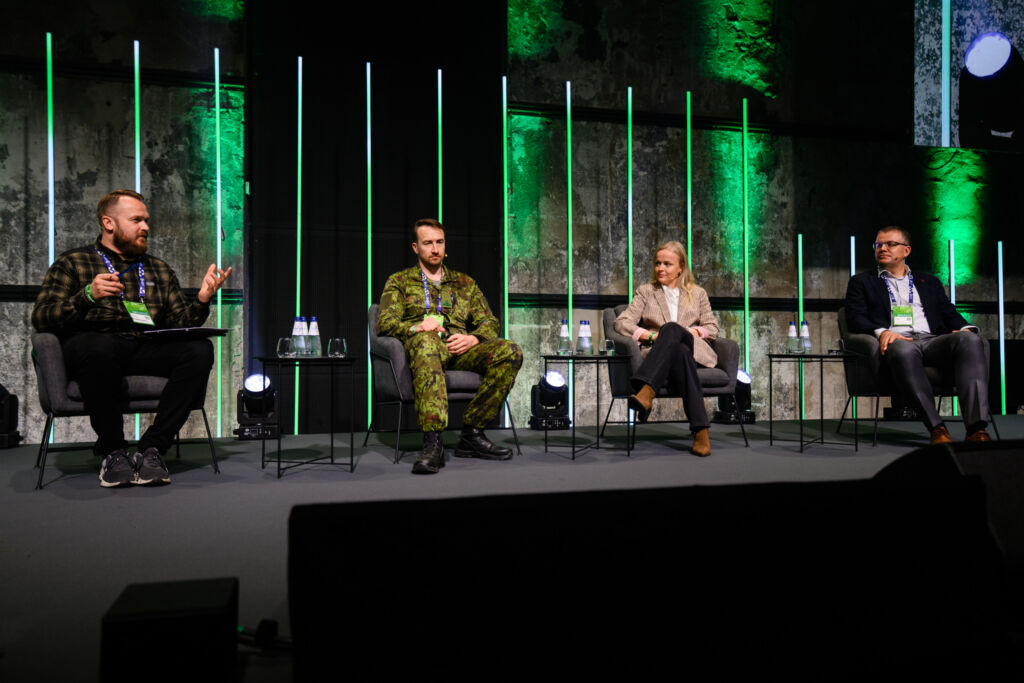
Kadri Tammai will take part in the panel “Dual-Use in Action: From Civilian Innovation to Defence Capability” at Defence Innovation Day. She will be joined by Kaimo Kuusk, Permanent Secretary at the Estonian Ministry of Defence, and Janne Hietala, CEO of Kelluu. The discussion will be moderated by journalist Kaur Maran.
Defence Innovation Day takes place on 21 September at Kultuurikatel in Tallinn. It is the first day of Estonian Defence Week. Participation is free of charge, but registration is mandatory and subject to approval.
The event is organised by Tehnopol and the Ministry of Economic Affairs and Communications through the NATO DIANA Estonian Accelerator. It is supported by the Estonian Ministry of Defence. One thematic block is shaped with the input from Sparkup Tartu Science Park.
Photos in order: Michael Guichard, NATO DIANA, Eiko Lainjärv
You might be interested in
EUDIS Defence Hackathon Autumn 2026: Meet the Innovators Shaping Battlefield Autonomy
From 15 to 17 October 2026, the EUDIS Defence Hackathon brought together innovators at eight locations across Europe to tackle a strategic theme at the heart of Europe’s defence and security priorities:...
Seven companies selected for Cyber Accelerator to develop new solutions for preventing cyber threats
Tehnopol Accelerator, in cooperation with the Estonian Information System Authority (RIA) and the European Cybersecurity Competence Centre (ECCC), runs the Cyber Accelerator, which supports cybersecurity startups in developing and bringing new products...
From Defence Business Lab to NATO DIANA: one stage, different steps in the defence innovation journey
On 24 September, 13 defence and dual-use companies presented their solutions at the Defence Business Lab Demo Day: ten startups completing the three-month pre-accelerator and 3 alumni of the NATO DIANA Estonian...