

24.03.2026
What most founders miss about the Baltic business ecosystem
For many founders, understanding the market begins with identifying competitors and potential customers. But in highly connected startup ecosystems like Estonia and the wider Baltic region, that view is only a small part of the picture.
What often matters just as much is understanding how companies relate to each other, which industries intersect, where leadership networks overlap, and how new ventures emerge from existing ecosystems.
In tightly connected markets, opportunity often appears not just within a sector, but between sectors and networks.
A dense and fast-moving ecosystem
The Baltic technology ecosystem has evolved through strong connections between startups, research institutions, investors, and established companies. Places like Tehnopol Science and Business Park play a central role in this dynamic. The campus hosts hundreds of technology companies and thousands of employees, while being closely integrated with Tallinn University of Technology and its research community.
This density creates an environment where founders, engineers, and researchers interact constantly, and where new ideas, companies, and partnerships often emerge from existing networks.
For founders operating in such ecosystems, understanding how organizations connect can be just as important as understanding the product they are building.
The challenge of seeing the whole market
Most company information already exists in public registries, reports, and databases, hence the challenge is not access to data, but rather the challenge is turning that information into a clear picture of how markets actually work.
Founders trying to map a sector often face questions like:
- Who are the companies shaping this industry?
- Where are potential enterprise customers located?
- Which organizations are connected through leadership or ownership networks?
- Which sectors are expanding fastest?
Answering these questions often requires extensive manual research across multiple sources.
A new way to view company ecosystems
Across Europe, new approaches are emerging that focus on organizing public company data into more navigable views of industries and networks.
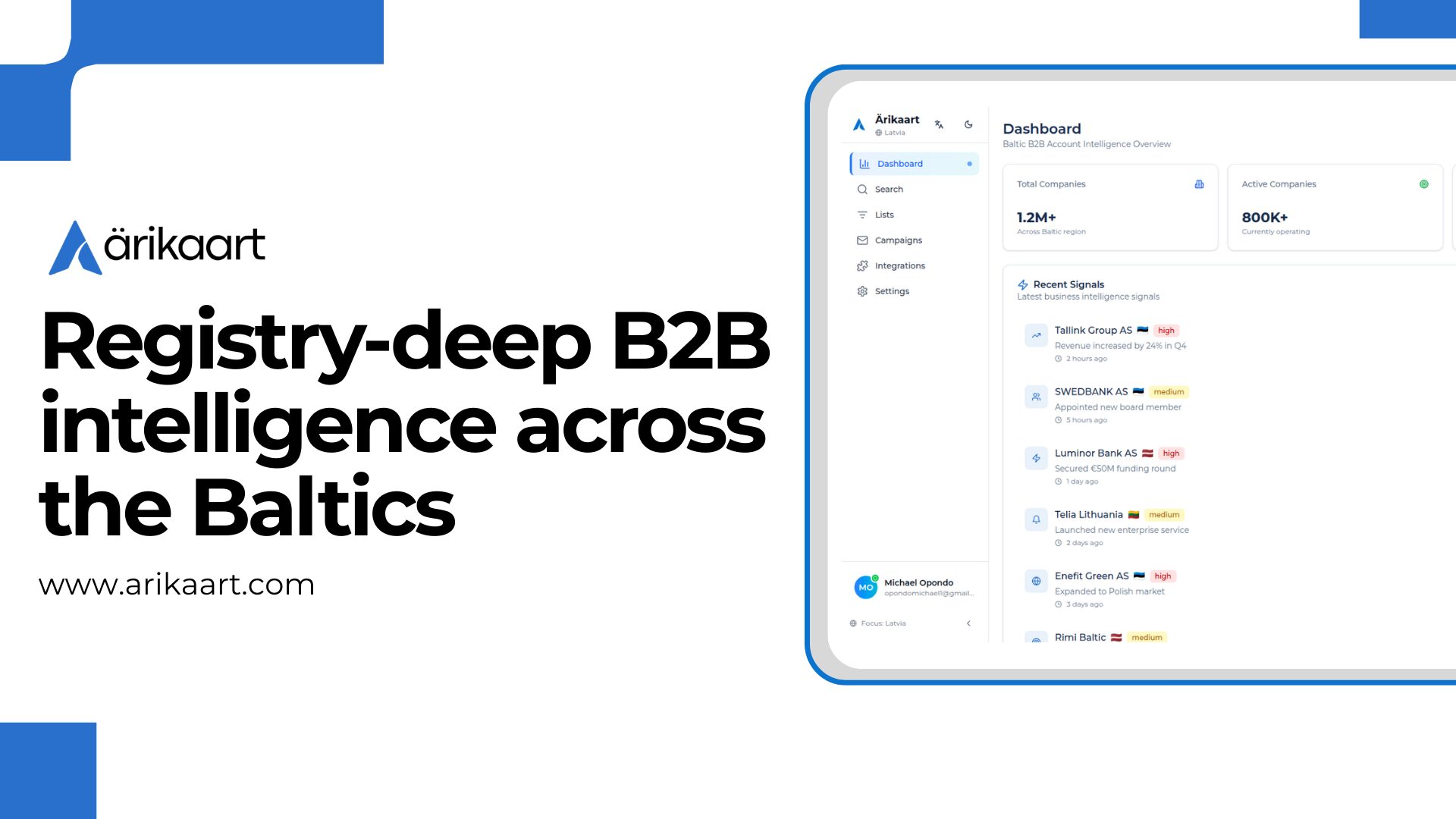
One such initiative emerging from the Tehnopol campus community is Ärikaart, an effort to explore how Baltic company information can be structured into clearer views of sectors, organizations, and leadership connections.
The goal with Ärikaart, a product of Kontorva Group, was not simply to list companies, but to also understand how the Baltic markets are actually structured, how companies connect, how industries evolve, and where opportunities appear between them.
The idea reflects a broader shift across startup ecosystems: moving from isolated company data toward ecosystem visibility.
Seeing opportunity differently
Over the past decade, the Baltic region has produced globally recognised technology companies while continuing to support a new generation of founders.
As the Baltic B2B ecosystems become more interconnected, across industries and across borders, understanding the structure of the surrounding business landscape may become an increasingly valuable capability.
For startups navigating complex and fast-moving markets, sometimes the biggest opportunities appear simply when the ecosystem becomes easier to see.