

04.12.2025
Building the future of welfare technologies
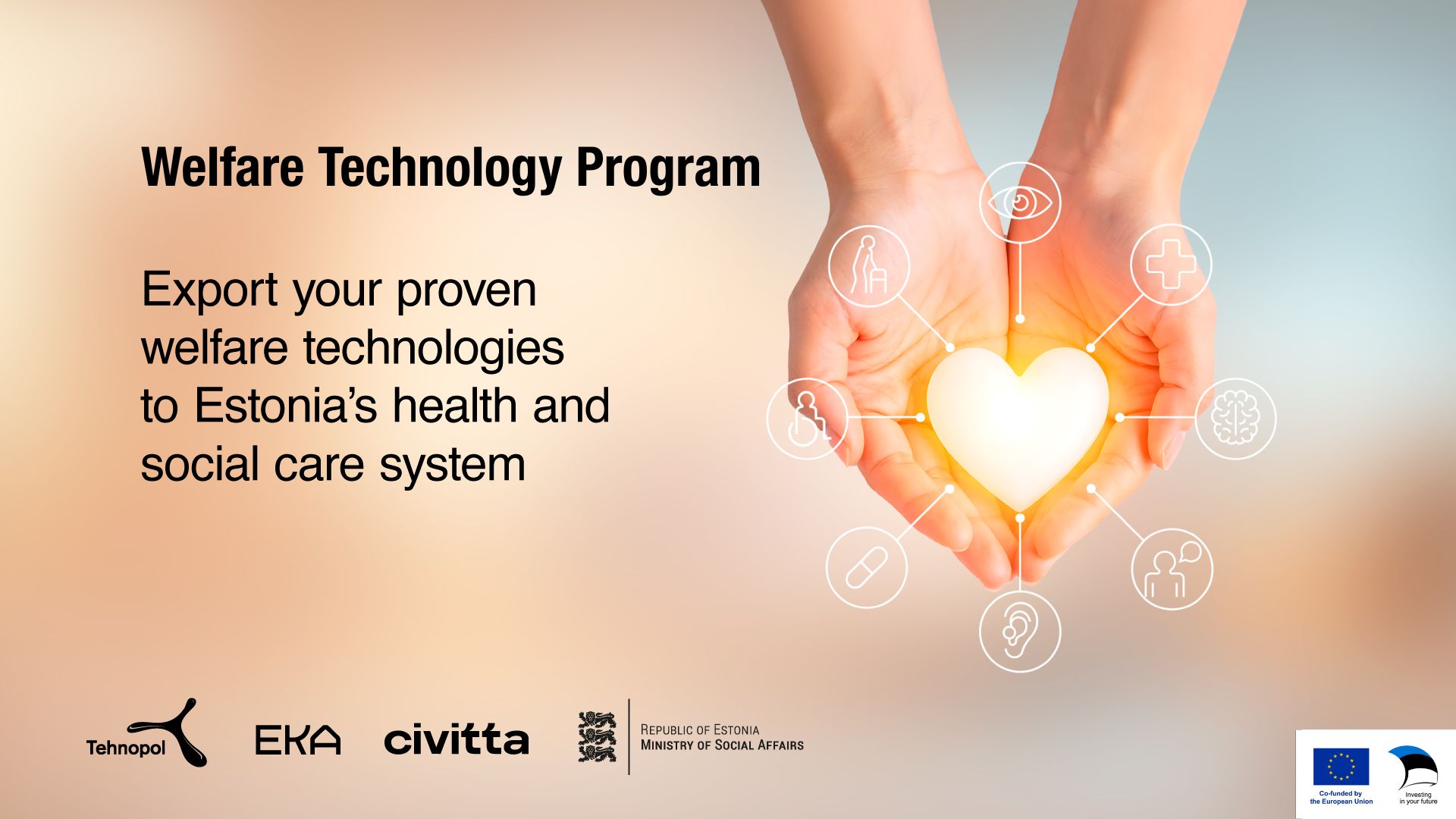
On 28 November, an information session for the Welfare Technologies Program was held to introduce the programme’s goals, participation conditions, and application process, as well as to answer participants’ questions.
Hanna Vseviov, Deputy Secretary General for Social Policy at the Ministry of Social Affairs, and Kitty Kubo, Lead of Innovation and Technology in Social Care, provided background why the program was created. The idea to develop such a program emerged several years ago, influenced by demographic changes and the rapid advancement of technology. In Estonia, more and more people need support from the social and healthcare sectors: in ten years, one quarter of the population will be over 65. According to 2024 data, 45% of older adults live alone, and 15% of adults in Estonia provide care to another person. About 2.5% estimate their care burden to be as heavy as a part-time job. Today, approximately 12,000 people live in care institutions across Estonia. Many are in care homes because home-based services are inadequate and the sector faces severe labour shortages. Innovation capacity in health and social care is relatively low. At the same time, Estonians are generally open to adopting technological solutions, which means the potential for meaningful change is significant.
Vseviov emphasised that although welfare technologies have been supported in the past and Estonia has forward-thinking actors in the field, these efforts have largely been project-based. She added: “We want the programme’s impact to be long-term and sustainable, with local governments working together to bring alive real change. The focus is on enabling people to live as independently as possible at home with the help of technological solutions.”
Both representatives from the Ministry highlighted that developing technologies from scratch is not the programme’s primary focus. Instead, the aim is to advance technologies already in use or adopt solutions proven elsewhere in the world. They stressed that participants should not start from the technology itself, but from the problem. It is important to understand the added value that technology can create, and to ensure that solutions can be scaled across Estonia.
To design and adopt such solutions, collaboration between the public and private sectors—and direct involvement of the target groups—is essential. The programme brings together national and local government agencies, health and social care providers, technology companies, researchers, and representatives of service users.
Programme objectives
- Extend the independent living of older adults and adults with support needs at home, by preventing or slowing the development of care needs and improving quality of life.
- Reduce the burden on family members who provide care.
- Improve the quality of services. Enhance service accessibility and increase job satisfaction among care workers through technology.
Welfare technologies include any solutions that support people with care needs in daily life and help service providers deliver more accessible and higher-quality services. Examples include wearable devices such as emergency buttons, smart home systems that enhance safety and support daily functioning, telehealth platforms, digital tools that support physical activity and mental well-being, medication-support technologies, and many other solutions that align with the programme’s goals.
The programme has over 15 million EUR available for project funding over four years. Support can be applied for in two connected stages: up to 30,000 EUR over a six-month period for developing a solution idea, and from 0.5 million EUR over up to 24 months for piloting, evaluating and adopting the solution (with 12% co-financing). Only solutions developed in the first stage may apply for the second stage. Participation in the first stage requires prior pre-application consultation.
In addition to financial support, all project teams take part in a development programme during project implementation. This offers structured innovation support based on a unified methodology, including workshops, mentoring, expert input, and study visits.
The first application round (for solution development) is expected to open at the end of December or start of January.
For more details, please watch the recording of the information session.
Next steps
Helen Staak, Head of Health Technologies at Tehnopol and Programme Lead for the Welfare Technologies Programme, encouraged participants to begin preparing now, as the application round will open soon.
She invited everyone to join the programme’s matchmaking events “Connecting Ideas and Action”, where participants can:
- present an important health or social care problem that could be addressed with technology, or
- share a solution idea to improve the daily functioning and well-being of older adults and people with support needs.
During the events, multidisciplinary teams will be formed around the problems and ideas presented. These teams will collaboratively develop the most impactful solutions—those best suited into the program.
The events bring together national and local government institutions, health and social care providers, technology companies, researchers, and representatives of service users.
Upcoming matchmaking events:
- 12 December 2025, 09:00–17:15 in Tallinn, Tehnopol (Teaduspargi 6/1). See agenda and register here.
- 9 January 2026, 09:00–17:15 in Tartu, Creative Industries Centre (Kalevi 17). See agenda and register here.
Participation is free of charge, but registration is required.
*Please note, that these events are in Estonian.
If you have any questions, please contact Programme Lead Helen Staak at helen.staak@tehnopol.ee.
The Welfare Technologies Development Programme is implemented by Tehnopol, Civitta and the Estonian Academy of Arts on behalf of the Ministry of Social Affairs. Project funding is co-financed by the EU Cohesion Policy 2021–2027 measure “Supporting the uptake of welfare technologies in health and social care”, and the development programme is co-financed by the EU Cohesion Policy 2021–2027 measure “Improving the accessibility and quality of long-term care”.