


31.03.2026
Dual-use technologies moving towards adoption at the NATO DIANA Estonian accelerator
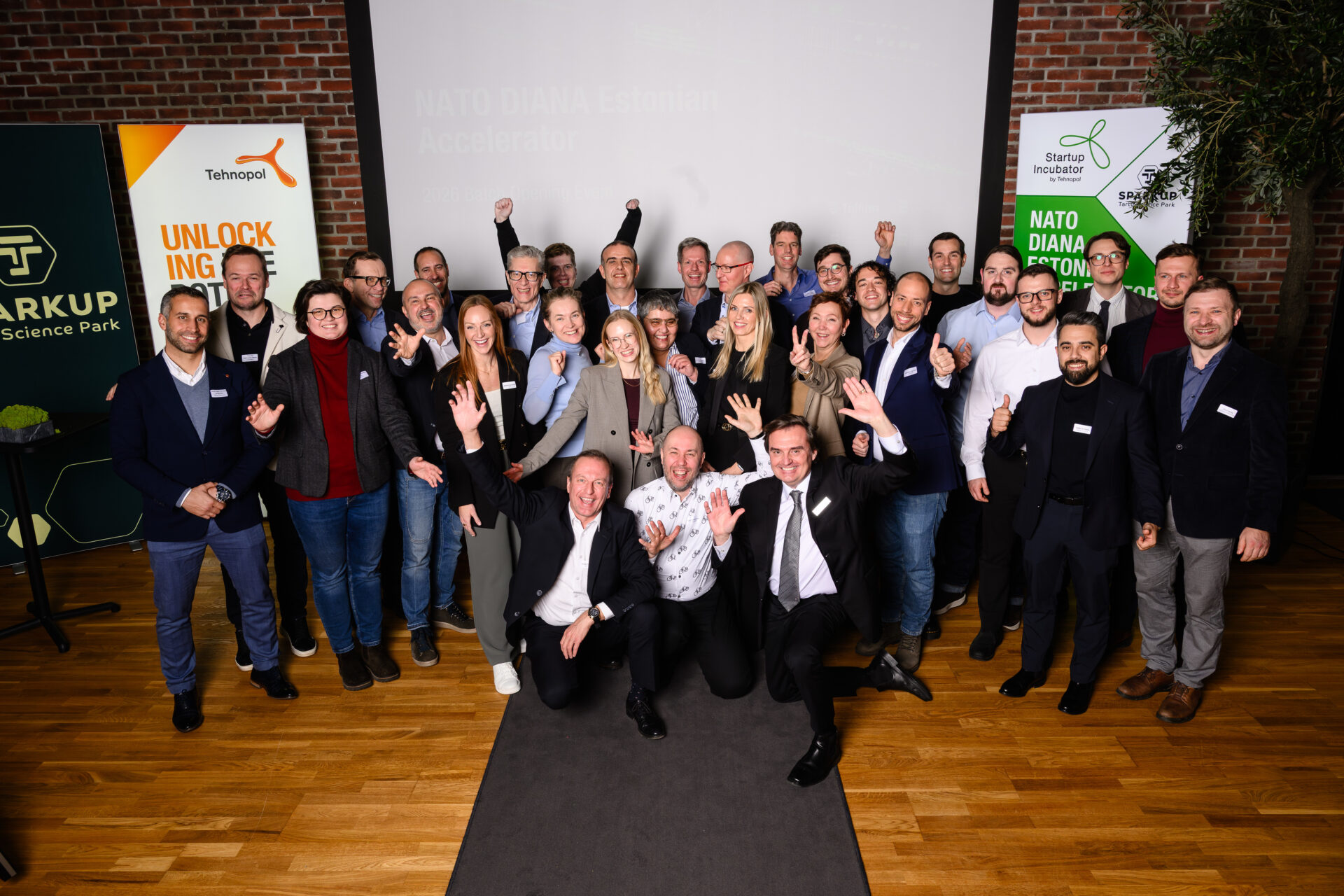
The 2026 NATO DIANA accelerator programme is currently underway. Out of 3,680 applicants across the Alliance, 150 companies were selected to develop their deeptech, dual-use solutions addressing urgent defence and security challenges. The programme is built around one outcome: adoption, bringing relevant technologies into use by NATO end users.
Twelve of these companies are part of the NATO DIANA Estonian accelerator, implemented by Tehnopol Startup Incubator in collaboration with Sparkup Tartu Science Park. This is Estonia’s third DIANA cohort, supported by an established programme structure and an active local ecosystem.
The cohort focuses on two challenge areas: maritime operations and data-assisted decision-making.
Companies in the programme engage directly with operational environments. In January, during the first onsite, teams visited Narva and met Estonian border forces operating on NATO’s eastern flank.
In March, the cohort travelled to Tapa army base, where they presented their solutions to Estonian, British and French NATO forces together with participants from the Danish DIANA accelerator.

Many of the companies bring extensive prior experience from civilian markets and are now adapting their technologies to defence use cases.
Maritime Operations
- Unplugged (Norway)
Unplugged develops wireless subsea power and data systems enabling persistent, high-endurance AUV operations in harsh offshore environments. Its technology removes the need for physical connectors, reducing maintenance and enabling reliable long-duration deployments. This supports continuous underwater operations across defence, infrastructure protection and offshore domains.
- Quantum Quest (Poland)
Quantum Quest develops autonomous systems for drones operating across air, sea, land and space domains. Its modular autopilot supports autonomous underwater operations and enables flexible integration across platforms. The system is designed for scalable deployment of autonomous capabilities across multiple environments.
- MAPS Messaging BV (Netherlands)
MAPS Messaging provides a protocol-agnostic infrastructure for real-time, secure data exchange in mission-critical environments. Its platform enables low-latency communication across fragmented systems and multiple protocols. This supports interoperability and decision-making across defence and civilian operational networks.
- EYE2DRIVE (Italy)
EYE2DRIVE develops AI-ready CMOS image sensors for situational awareness and threat detection in low-light and complex environments. Its vision system adapts dynamically to changing conditions, supporting navigation and monitoring in challenging settings. The technology improves reliability and performance across autonomous and mission-critical applications.
Data-Assisted Decision Making
- Hightek SRL (Italy)
Hightek delivers end-to-end software and hardware for data fusion, predictive analysis and operational decision-making. Its cloud-based platform integrates multi-source data into predictive digital twins. This improves situational awareness and reduces operational errors across civil and defence scenarios.
- Datambit (UK)
Datambit provides AI-driven deepfake detection for audio and video to support operational integrity. Its technology identifies manipulation in real time by analysing subtle inconsistencies in data streams. This enables organisations to verify information authenticity and respond to misinformation in high-risk environments.
- Aereus (Germany)
Aereus develops an AI-native data engine for scene intelligence supporting infrastructure protection and emergency response. Its platform fuses and structures incoming data into a unified intelligence layer. This enables faster decision-making in fragmented civilian and military data environments.
- Datifex, Inc. (Canada)
Datifex develops software platforms that transform complex operational data into interactive 3D environments. Its system integrates multi-source inputs to support situational awareness and reduce cognitive load. This enables faster decision cycles through contextualised, real-time intelligence.
- VIG-SEC DRONE S.L. (Spain)
VIG-SEC Drone develops a dual-use airspace management platform for coordinating manned and unmanned systems. Its solution integrates sensor data, video streams and operational inputs into a unified command environment. This enables real-time coordination and improves safety and interoperability in complex airspace operations.
- CulturePulse (Slovakia)
CulturePulse develops AI systems that create psychologically realistic digital twins for decision-making. Its platform combines survey data, OSINT and proprietary datasets to simulate behaviour and test strategies. This supports scenario analysis, operational planning and policy development.
- Blue Team Intelligence B.V. (Netherlands)
Blue Team Intelligence provides global, high-resolution 7-day predicted soil trafficability insights. Its solution uses satellite data and AI models to generate predictive terrain analysis and mobility indicators. This supports planning for movement, logistics and operational deployment.
- SkyFi (United States)
SkyFi provides an Earth intelligence platform integrating diverse geospatial data sources. Its system enables access to satellite imagery and analytics for enterprise and government users. This supports mobility and operational decision-making in contested and crisis environments.
The NATO DIANA Estonian accelerator is funded by the Ministry of Economic Affairs and Communications, with support from the Ministry of Foreign Affairs of Estonia, the Ministry of Defence and the City of Tallinn.
The programme continues with further onsites in Estonia in April and May, followed by final Demo Days in Paris in June.
Photo: cover photo by Eiko Lainjärv